


.svg)
.svg)


.svg)
∙ 0 min read
Scaling With Culture: Fanvue's Marcela Stamenov Wins Gold at the Stevie Awards

Author: María José Bianchi
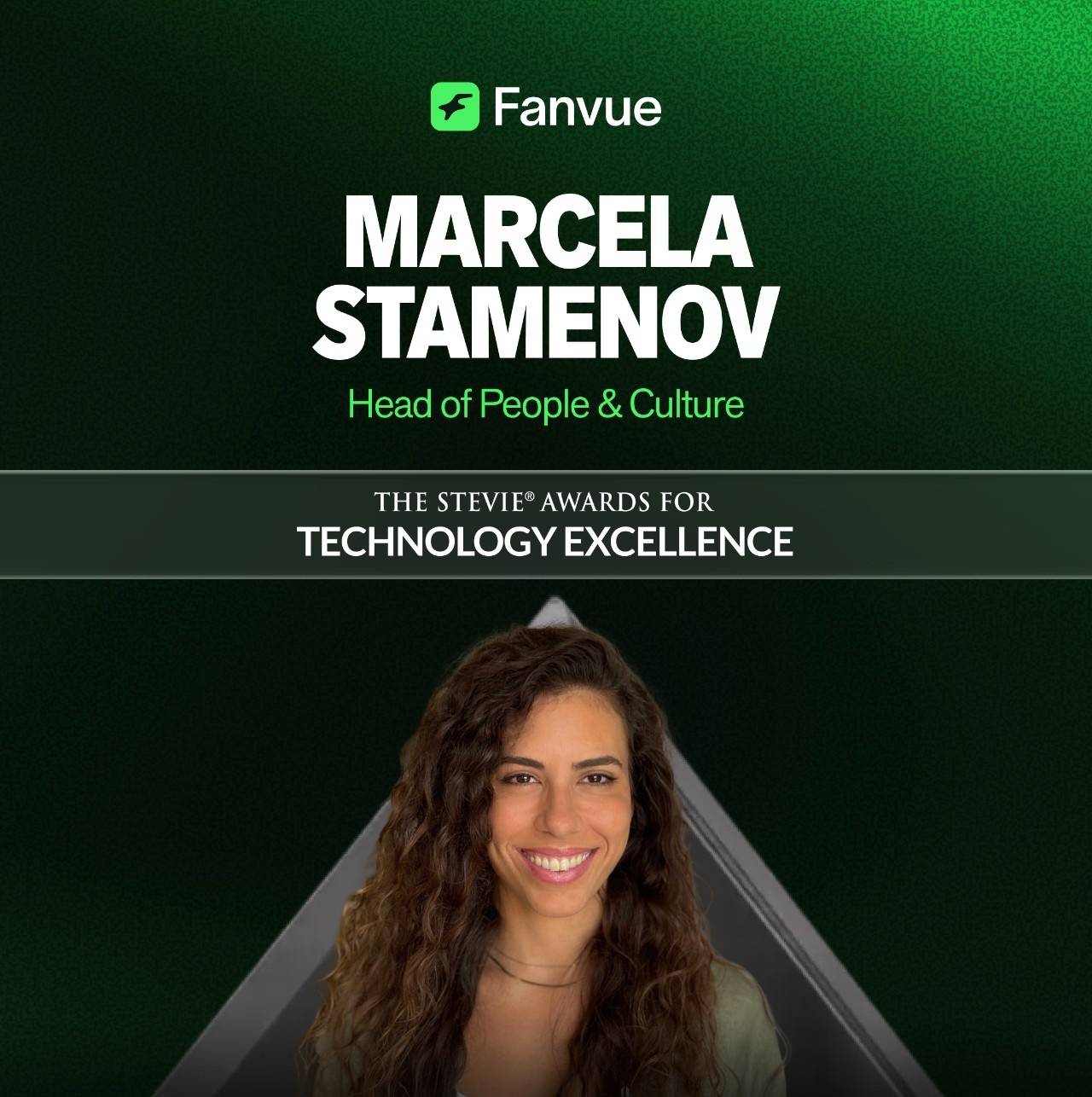
At the 2026 Stevie Awards for Technology Excellence, Fanvue took home two Golds: Company of the Year and Employee of the Year, the latter awarded to Marcela Stamenov, Fanvue's Head of People & Culture.
Winning both categories in the same year, in an award decided by more than 160 professionals worldwide, is a highlight to remember for both Fanvue and Marcela.
Behind Fanvue's headline numbers, including a $200M+ run rate and 450% revenue growth year on year, sits a people operation that had to be built almost entirely from scratch, while the company was already moving at full speed. This was what Marcela did.
In the words of one of the judges:
“Marcela Stamenov presents an exceptionally strong nomination demonstrating how strategic people leadership can directly enable technology-company hypergrowth. The intentionality behind building the team and the business really stands out."
This is the story of how this achievement came to be.
Marcela Joined A Hectic, 40-Person Startup
When Marcela joined Fanvue 2 years ago, it had the hectic setup of a 40-person startup that was growing fast. But she instantly connected to the founders’ vision and wanted to join.
Day one was a challenge: Different team members reached out to her on multiple channels with a variety of instructions. It was overwhelming, but also an opportunity for her to deliver value fast. As Fanvue had just begun hiring globally, she wanted every new joiner to feel like they belonged from the start. So she decided to start by building a proper onboarding process.
And within a month, she had delivered it with the support of a team that was united in their energy, drive, and mission.
This was just the first of many milestones. She went on to build the entire people function without losing out on quality of talent and employee satisfaction, all while the company grew its headcount to 130+.
Fanvue Strengthens Its Culture Through A Hypergrowth Phase
For tech companies, a main challenge during hypergrowth is hiring quality talent at scale while retaining the company culture, and many get it wrong.
Fanvue faced the same roadblocks. As the company kept outgrowing its own systems, projects often ended up with a shelf life as short as six months. But Marcela saw this as a chance to innovate and make bold bets.
“When you see the bar on anything that you do is constant and not evolving, that's the moment you realize it's already moving down.”
That meant constantly looking at how things were done and asking whether they were still good enough for where Fanvue was going. And she delivered.
Fanvue currently holds a 97% offer acceptance rate and fills more than half of its roles in-house, in a hiring market where the industry norm sits closer to 20–30% for internal hires. They also complete new hires within 14.5 days, compared to the 40 days most tech companies take.
These results came from changes to the foundation. Marcela designed processes to make sure Fanvue was hiring the best people who would become the ones carrying the culture forward.
Raising the bar on hiring
Rethinking hiring, her team prioritized a "culture add over culture fit" approach: Candidates are assessed on what they bring that the company doesn't already have, rather than on how neatly they blend into what already exists.
In this process, they made mistakes. At one point, speed took priority over planning, and some wrong hires were made.
The correction was a shift to a more deliberate approach to hiring, built on an 80/20 principle: 80% of the effort now goes into planning the role, and only the remaining 20% into filling it.
Now, before opening a role, the main question the team asks is what that role actually needs to achieve, and whether existing capacity or AI could solve the problem. With this, open roles dropped from around 30 down to 5 or 6.
“It's not even fair to people to hire someone if we're not really 110% sure we need it,” Marcela says.
The one single focus is on bringing in exceptional people who raise the bar across the team and the company.
“This is how you create a culture, because if you bring in just 1 or 2 people (who don’t meet high standards)...you demotivate and push the morale down of the whole team.”
Making culture part of the day to day
Hiring the right people is the first part of building a culture. The rest is about how deeply these people are embedded in the business and how strongly they feel connected to the organization. As Marcela says:
“Culture is what happens when the founders are not in the room.”
For this, her team identified “culture carriers”: 20 to 50 people in the organization who can carry the mission, values, and direction to their own teams and to new joiners, without the founders needing to be present.
The hiring approach also shaped the gender balance in the leadership team. According to Marcela, this balance is all because they consistently looked for the strongest candidate.
“We never had an approach that a man or a woman can do this job better. It was never allowed, because everyone has the same opportunity. We were always just focused on finding the absolute best person for the job."
And underlying all of this is a straightforward philosophy: treats employees like adults. Fanvue gives its people full ownership of their work, trusts their competence from day one, and holds them accountable.
This creates a culture that people live every day.
“People are not behaving that way because someone told them; they behave like that because they expect that from themselves, the same way they expect it from other people and the founders. And they call it out when it's not like that.”
The results are reflected in Fanvue's workplace intelligence data: 89% employee engagement, 16% above the sector benchmark; 87% confidence in management; and a flight risk of just 6% against an industry norm of 40%.
And Fanvue’s been named a Sunday Times Best Place to Work for 2 years back to back, plus it received a Business Culture Leadership Award in 2025.
With AI, Fanvue Holds the Line Firm
Fanvue empowers its creators with AI tools to scale their business, but believes that connection can only be built when human judgment and discretion are available when they’re needed. It’s the same philosophy teams follow internally.
For example, rather than paying an external vendor for a recognition tool, Marcela built one herself. Her Kudos app ties peer recognition directly to Fanvue's core values.
“It took me a few weekends to build it in a way that we wanted. It was designed visually as we wanted. Now people come to me with features they want additionally, and I just go and implement it, and that's it.”
But she’s clear that AI isn't a substitute for human decision-making in sensitive situations, and personnel decisions sit firmly in that category.
“We will never bring AI to judge on a person's situation, like whether we would hire someone, or how we would, you know, resolve a certain challenging situation.”
She describes AI more as an executive or personal assistant: a tool that helps clarify a message, speed up the work around a decision, and improve the quality of what gets communicated, without making the decision itself. It's a mindset rather than a specific tool:
"How can AI accelerate what I'm doing? How can AI power me personally to do the better job, smarter, faster?"
That question runs across the whole business.
The Two Awards Tell the Same Story
Last year, the Stevie Awards named Fanvue as the Fastest Growing Company. This year, with the Gold for Company of the Year, the story has progressed: from how quickly the company grew, to the quality of the company being built.
To put this into perspective, only 1.5% of VC-backed startups ever reach $100 million ARR. Fanvue did it while expanding its headcount by almost 10 times.
The judges' comments on Fanvue's entry focused on the business itself:
"Fanvue presents an incredibly compelling case for how AI is fundamentally reshaping the creator economy by scaling authentic audience connections rather than just content volume. The explosive 450% revenue growth, a $22 million Series A, and hard metrics make this a remarkably strong and commercially validated idea."
But these numbers all sit directly on top of the effots of every employee that Marcela help bring in, during the same period, at the same speed.
That's why the two awards are part of the same story: One recognizes what Fanvue grew into, while the other recognizes the leadership that made it possible.
The Next Stage: Continued Growth
As the company sets its eyes on growing the team, Fanvue’s systems will keep changing, but Marcela knows what she wants to hold on to: the simplicity, transparency, async communication that works across time zones, and sense of ownership that made the early team move the way it did.
What will become more of a priority is making sure employees stay aligned rather than drifting into silos as more people join. And one way Marcela and her team will do this is by focusing on leadership maturity, on doubling down on the “culture carrier” strategy.
Across this growth journey, the people team’s mission will remain the same, Marcela says.
“Whenever someone comes in at Fanvue, we want them to have this experience, something truly brilliant, like ‘I was really accelerating myself as a person as I've never done before’. We invest a lot in that, and not just offering people a job. So we will invest more to provide people with more growth, more opportunities, more learning, to create something that's not siloed or disconnected, but actually works and functions with us all together, wherever we are.”
Marcela has built the same legacy at Fanvue:
"I'm really proud of who I grew as a person in these two years. This didn't just allow me to build someone else's business. I know I'm leaving my mark here."
.png)


.svg)

.svg)
.svg)
.svg)
.svg)
.svg)
.svg)
.svg)